The stones
Let's talk about the diamond.
A lab-grown diamond is crystalline carbon, grown from a seed rather than dug out of the ground. That sentence is the whole answer. Everything under it is here because you may want to check it — how the stone is made, how it compares with a mined one property by property, how it is graded, and how to verify the grading yourself without taking a word of this on trust.
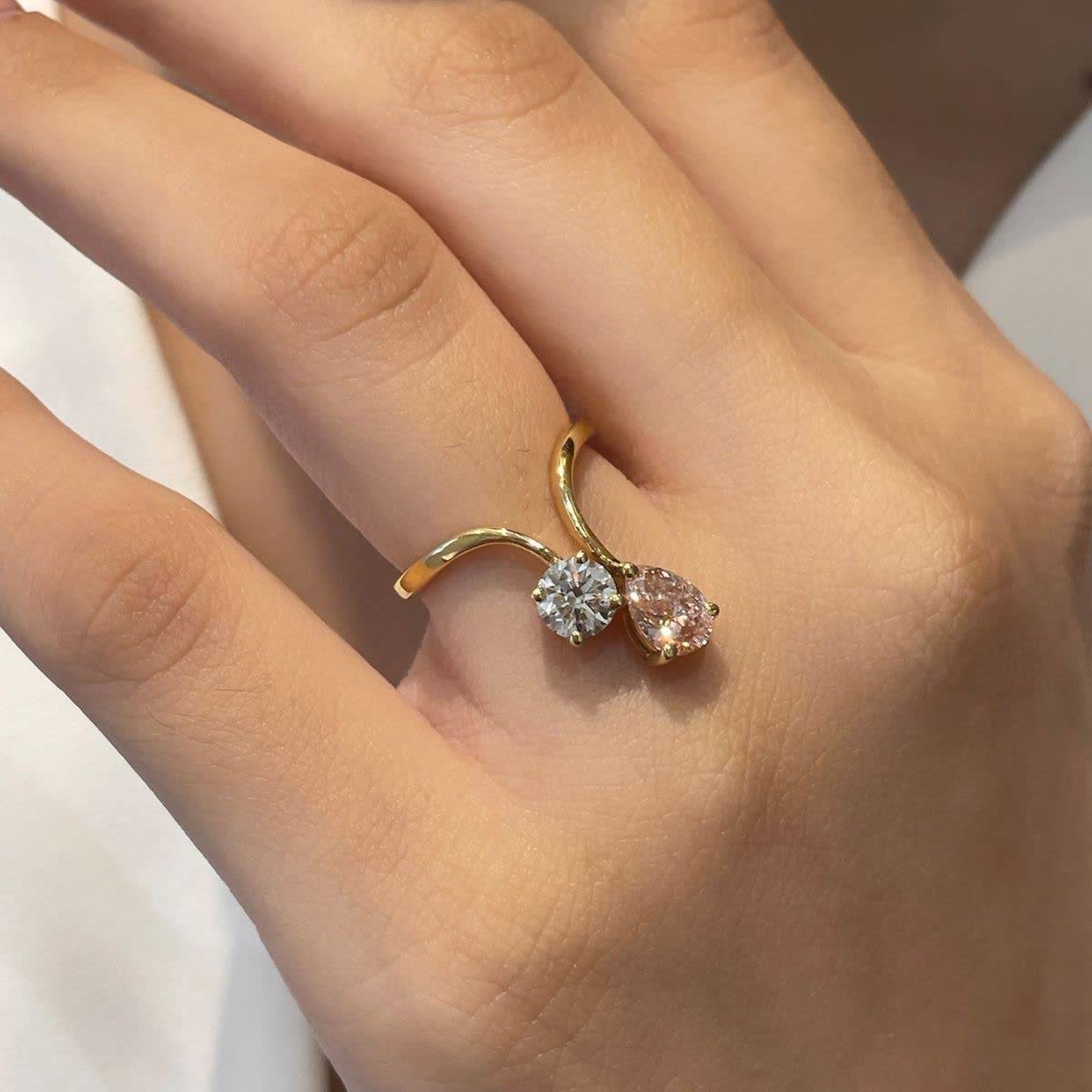
Three questions
Everyone asks the same three things
- Is it a real diamond?
- Yes. It is a real diamond.
- Will anyone know?
- Not by looking. Lab-grown and mined diamonds share the same essential physical and optical characteristics.
- Can I verify it?
- Absolutely. Eligible diamonds are independently certified and can be verified through their grading documentation.
Trust
You will never have to take our word for it.
IGI Certified Diamonds
Every centre stone reported by IGI, with the number on the stone
Transparent Diamond Information
The full specification and the plotted clarity diagram, before you decide
Personalised Guidance
Including where a higher grade stops being visible on a hand
Designed Around Your Budget
The budget comes first, because it decides which stones are on the table
How it is grown
Carbon, a seed,
and a few weeks
HPHT — high pressure, high temperature
The older of the two methods, and the more literal one: it reproduces the conditions found under the earth’s crust. The seed sits in a carbon source with a metal flux and is pressed at roughly five to six gigapascals while being heated past 1,300 °C. Carbon dissolves into the flux and crystallises onto the seed. The same process is also used after growth, as a treatment to improve colour.
CVD — chemical vapour deposition
A low-pressure method. The seed sits in a vacuum chamber filled with a carbon-bearing gas, usually methane mixed with hydrogen. Microwave energy breaks the gas into a plasma, and carbon atoms settle onto the seed one layer at a time. Growth is slower and more controlled, and it is the easier route to large, clean, colourless stones.
Either way, the rough comes out of the reactor and goes to a cutter — and from that point on nothing is different. Planning, sawing, bruting, faceting, polishing: the same steps, on the same machines, very often in the same workshops in Surat and Mumbai that cut the mined rough.
Side by side
The sameness is the important part
| Property | Lab-grown | Mined |
|---|---|---|
| Where they are identical | ||
| Chemical composition | Pure crystalline carbon | Pure crystalline carbon |
| Crystal structure | Cubic lattice | Cubic lattice |
| Hardness | 10 on the Mohs scale | 10 on the Mohs scale |
| Refractive index | About 2.42 | About 2.42 |
| Dispersion — the fire | 0.044 | 0.044 |
| Brilliance | Identical. There is no visual difference to look for. | Identical. |
| On a diamond tester | Reads as diamond | Reads as diamond |
| Where they differ | ||
| Origin | Grown from a diamond seed in a reactor, over a matter of weeks | Formed over a billion years or more, then mined |
| Supply | Production can be scaled to meet demand | Finite, and controlled by a small number of producers |
| Price at the same specification | A fraction of the mined price. Published Indian comparisons span roughly 30% to 90% less, depending on carat weight, colour, clarity and which laboratory graded the stone. | The baseline the comparison is made against |
| Grading | IGI issues full 4C reports. GIA moved to descriptive tiers on 1 October 2025. | Full 4C reports from every major laboratory |
| Identification | Separated by growth patterns and fluorescence under laboratory instruments — not by eye, and not by a hand-held tester | — |
| Resale | A young market, and production costs are still falling. We publish an exchange and return policy rather than a value claim. | An established secondary market, though not a generous one |
Nothing in the first group is a marketing position. Those are measured properties, and any gemological laboratory will confirm every one of them on request.
What it is not
A simulant is not a diamond. This is.
Lab-grown diamond
- Material
- Carbon (C)
- Hardness
- 10 on the Mohs scale
- Refractive index
- About 2.42
Diamond. Grown rather than mined, and identical in every measured property to a mined stone of the same specification.
Moissanite
- Material
- Silicon carbide (SiC)
- Hardness
- About 9.25 on the Mohs scale
- Refractive index
- 2.65 to 2.69
A different mineral. It is doubly refractive, so facet edges appear doubled under magnification, and its dispersion is more than twice that of diamond — the rainbow flash some people prefer and others read immediately as not-diamond.
Cubic zirconia
- Material
- Zirconium dioxide (ZrO₂)
- Hardness
- About 8.25 on the Mohs scale
- Refractive index
- About 2.16
A different material again, and much softer. Facet edges abrade with ordinary wear and the stone goes visibly cloudy over a few years.
The thirty-second check
A standard diamond tester reads a lab-grown diamond as a diamond, because it is one. The same tester rejects cubic zirconia outright. Moissanite is the one that needs care: it conducts in a way that can fool an older thermal-only probe, which is why every tester built since moissanite reached the market checks electrical conductivity as well.
If you are being shown a stone anywhere — by us or by anyone else — and you want to know what it is, this is a thirty-second check that any jeweller should be willing to do in front of you.
None of this makes moissanite a bad stone. It is a legitimate material with its own following and it costs less again. It is simply not diamond, and it should never be sold as though it were.
Grading
The four Cs, without the mystique
Carat
Weight, not size.
One carat is 0.2 grams, divided into 100 points — so a 0.75 carat stone is “75 points” in the trade. Carat measures weight alone, which is why two stones of the same weight can look different sizes: weight can be carried down in the depth of the stone, where it does nothing at all for how large the stone looks face-up.
Prices step at the round numbers. A 0.90 carat round costs meaningfully less than a 1.00 carat, and the difference in diameter is about two tenths of a millimetre — not something anyone sees on a hand.
What we would tell you: if the number itself matters to you, buy the number. If the look matters, buy just under it and put the difference into cut.
Colour
Graded D to Z, measuring the absence of colour.
D, E and F are colourless; G to J are near-colourless. Below about H, warmth starts to become visible against a white metal. The scale measures unwanted colour only — a stone with colour strong enough to be desirable leaves this scale altogether and is graded as a fancy colour.
The metal changes the answer. Yellow and rose gold lend warmth back to the stone, so you can go further down the scale without noticing. In platinum or white gold, a warm stone shows sooner.
What we would tell you: the difference between D and G is very hard to see once a stone is set and there is nothing beside it to compare against. With lab-grown stones the premium for the top grades is often small, so this is one place where paying up is cheap — but we will still say when it is not worth it.
Clarity
Internal features, assessed at ten times magnification.
The scale runs Flawless and Internally Flawless, then VVS1 and VVS2, VS1 and VS2, SI1 and SI2, and finally I1 to I3. Every one of those grades is assigned under a loupe at 10× — which is not how anyone looks at a ring.
The question that actually decides whether you like the stone is different: is it eye-clean at normal viewing distance? Most VS2 stones are. Many SI1 stones are too, and a well-placed SI1 is indistinguishable from a VVS on the hand while costing a good deal less.
What we would tell you: position matters more than grade. An inclusion sitting under a prong is invisible; the same inclusion under the table is not. Every IGI report carries a plotted diagram showing where the inclusions actually are, and we will go through it with you.
Cut
The only C that is workmanship rather than material.
Cut is what decides whether a stone looks alive. It is graded Excellent down to Poor on round brilliants, alongside separate polish and symmetry grades. Round is the only shape with a fully standardised cut grade, so on fancy shapes you have to read the proportions off the report instead of relying on a single word.
What we would tell you: a poorly cut D Flawless will look duller on a hand than a well-cut G VS2, and it will cost more. If something in your budget has to give, do not let it be this one.
Shapes
Eight outlines, and what each one is doing
Round brilliant
Fifty-seven or fifty-eight facets arranged to return as much light through the top of the stone as possible. It is the most brilliant shape and the most expensive per carat, because roughly half the rough is lost getting there.
Oval
A stretched brilliant. It reads larger than a round of the same weight because the outline is longer, and it lengthens the finger. Watch for a bow tie — the dark band across the middle that appears when the proportions are wrong.
Pear
Round at one end, pointed at the other, and usually worn with the point towards the fingertip. It carries the same bow-tie risk as an oval, and the point needs a prong over it or it will chip.
Emerald
A step cut rather than a brilliant: long parallel facets that give broad flashes instead of sparkle. It shows clarity plainly, so inclusions have nowhere to hide. This is the shape to spend on clarity for.
Cushion
A square or rectangle with rounded corners and larger facets, giving a softer and warmer flash than a round. It holds colour well, which is why so many fancy colour stones are cut this way.
Marquise
A pointed ellipse, and the shape that gives the most apparent size for its weight. Both points are fragile and both need covering by the setting.
Heart
The hardest shape to cut convincingly. The two lobes have to match, the cleft has to be sharp, and below about three quarters of a carat the outline stops reading as a heart at arm's length.
Princess
A square brilliant, with nearly the light return of a round and far less rough wasted, so it costs less per carat. Its corners are the most vulnerable point on any diamond and the setting has to protect them.
We will lay several shapes at the same carat weight in front of you at a consultation. The difference in apparent size between a round and a marquise of identical weight is larger than any description of it, including this one.
Certification
The one check you can do without us
What is on the report
Shape and cutting style, measurements in millimetres, carat weight, colour grade, clarity grade with a plotted diagram showing where the inclusions sit, cut, polish and symmetry grades, fluorescence, and a statement that the stone is lab-grown together with the method used to grow it.
The number is on the stone
The report number is laser-inscribed on the girdle — the thin band around the widest part of the stone. The characters are far too small to see unaided; you need a loupe or a microscope, and we will put the stone under one for you. That inscription is what ties the piece of paper to the object.
Verify it before you pay us anything
Enter the report number on IGI’s own verification page and the laboratory will return the report it issued against that number. Compare it, line by line, with the paper in your hand. If anything differs, walk away — from us, or from whoever else is holding the stone.
We are telling you to do this because it is the strongest check available to a buyer and it costs nothing. A jeweller who would rather you did not is telling you something.
Verify a report at igi.org (opens in a new tab)
What changed in 2025
On 1 October 2025, GIA stopped issuing 4C colour and clarity grades for lab-grown diamonds and moved to descriptive tiers — “Premium” and “Standard”. IGI continues to issue full 4C reports, and grades the large majority of lab-grown stones.
This matters to you in two ways. A badge reading “IGI or GIA certified” no longer describes the same document depending on which laboratory graded the stone in front of you. And comparing two sellers only works if both reports are on the same scale. Every Pexa Diam centre stone is reported by IGI, so every stone we show you can be compared with every other one — and with anyone else’s IGI-graded stone.
What is not individually certified
Accent and pavé stones are not individually reported — not by us, and not anywhere in the trade, because grading a two-point stone costs more than the stone is worth. We state their total weight and their colour and clarity range, and we do not describe them as certified.
We also do not issue a certificate of our own. A document a seller writes about their own goods is not independent, and we would rather hand you one that is.
Resale
We are not going to tell you this is an investment
Resale markets for lab-grown diamonds are young, production capacity has grown quickly, and the price of the stones has fallen year on year. Nobody can tell you what one will fetch in ten years, and anybody who gives you a confident number is guessing.
Some of this is true of mined diamonds as well, in a way the trade is quieter about — a retail price includes a margin that does not come back to you on resale. But the uncertainty is larger here, and we are not going to hide behind the comparison.
So we do not make a value claim. We publish a policy instead, because a policy is a thing we can be held to.
What we publish instead
Confidence beyond the first choice.
80% Exchange Value
Eligible PEXA DIAM jewellery can be exchanged for 80% of its billed value, subject to our exchange policy.
70% Return Value
Eligible PEXA DIAM jewellery can be returned for 70% of its billed value, subject to our return policy and applicable terms.
- The conditions attached to both values are being finalised, and the policy page says plainly which parts are settled and which are not.
Next
Photographs flatten a diamond
Still deciding? The full list of questions covers ordering, sizing, payment and delivery, and the ring size guide explains how to measure at home.